A fast, stimulating, pull-heavy walk revs a dog’s nervous system instead of settling it. The fix is rarely a longer walk. It is a slower one that lets your dog decompress, lowering their arousal by processing the world at their own pace.
Quick Answer: A dog who comes home from walks more wound up than when they left is usually over-aroused, not under-exercised. A fast, stimulating, pull-heavy walk raises a dog’s arousal instead of lowering it, so the dog comes home with their nervous system still running hot. The fix is not a longer walk. It is a slower, sniff-led walk that lets the dog set the pace and process the world at their own speed. This kind of walk, a decompression walk, helps a dog regulate and come home settled rather than wired. It is not better than other walks. It is the right walk for a dog who needs to come down rather than rev up.
I bring an unusual combination to dog walking: a psychology degree, a Washington Humane Society background dating back to 2007, and Fear Free and BAT Foundations certification most Capitol Hill dog walkers simply don’t have. I’m also Pet First Aid and CPR certified, and I personally train every walker on my team before they take on their first client. The rest I learned by reading a lot of dogs, one at a time. Here is what’s actually going on when your dog comes home wired, and what the right walk does about it.
What Does It Actually Mean When a Dog Comes Home Wired?
A wound-up dog is not a badly behaved dog. They are an over-aroused one.
Arousal is just the level of activation in a dog’s nervous system, how revved up they are. A walk can raise it or lower it depending on what the walk asks of the dog. A high-energy dog who spends a walk reacting to everything, other dogs, traffic, fast movement, a hundred competing inputs, comes home with the dial turned all the way up. They are not being difficult. Their system simply has not had a chance to come back down.
This matters because the behavior people read as a problem, the pacing, the inability to settle, the restlessness, is usually the dog telling you the walk did not meet them where they were.
Why Does a Busy Capitol Hill Walk Wind Some Dogs Up?
Capitol Hill is a lot of dog input packed into a small space.
A single twenty-minute loop can take a dog past a motorcade on Constitution, the bus braking and hissing on 8th Street, a crowded stretch of Eastern Market on a Saturday, and a dozen other dogs on leash. For a sensitive or high-energy dog, that is not a relaxing stroll. It is a sensory firehose. Every passing dog is a decision. Every loud noise is a small jolt. Every delivery truck, scooter, and stroller is one more thing to track.
The density is the issue. In a quieter suburb, a dog might walk for ten minutes before encountering anything that raises their arousal. On the Hill, the inputs come one after another with barely a gap between them. There is no stretch of nothing for the nervous system to reset against. A dog who is already prone to running hot never gets the chance to come back down, because the next trigger arrives before they have settled from the last one.
Certain blocks make this worse than others. The commercial corridors, Pennsylvania Avenue SE, the blocks around Eastern Market and 8th Street, Barracks Row on a weekend, stack the most stimulation into the least space. Foot traffic, restaurant patios, other dogs, constant movement. For a wound-up dog, those are the hardest routes to walk, and they are often the default simply because they are the most direct.
None of that is the neighborhood’s fault, and it is not your dog’s fault either. It is simply the environment, and it is part of what makes living here wonderful for people and demanding for certain dogs. The question is not whether Capitol Hill is too busy for your dog. It is whether the walk works with that environment or fights it. A walker who knows the Hill block by block can route a sensitive dog onto the calm residential streets and skip the gauntlet entirely.
Is My Dog Just Under-Exercised?
This is the assumption almost everyone reaches for first, and it is the one most likely to make things worse.
The logic seems sound: a wound-up dog has energy to burn, so burn more of it. But for an over-aroused dog, more distance and more stimulation pour fuel on the fire. You can walk a dog like this for an hour and bring home a dog who is exhausted and still cannot settle, because the body is tired but the nervous system is still running hot.
Physical tiredness and nervous-system calm are not the same thing. A dog can have both, one, or neither. The wound-up dog usually has the first without the second.
What Is a Decompression Walk?
When a dog needs to come down rather than rev up, the walk that does it is a decompression walk.
It is slow, sniff-heavy, and led by the dog. The pace is unhurried on purpose. The route is quiet on purpose. The walker follows the dog rather than steering them, letting the dog choose where to go and how long to linger. Where a stimulating walk asks a dog to react, a decompression walk asks nothing and lets the dog simply process. The goal is a dog who comes home regulated and settled, not one who has covered the most ground.
It is worth saying plainly: this is not a better walk than any other kind. It is the right walk for a particular dog on a particular day. A dog who needs a brisk, engaging walk would be under-served by this one. Matching the walk to the dog is the whole point.Why Does Sniffing Calm a Dog Down?
The nose is the mechanism, and it is not a small one.
When a dog sniffs, they are doing real cognitive work, gathering and processing an enormous amount of information about who passed by, when, and in what state. That focused, self-directed activity engages the part of the nervous system responsible for rest and recovery rather than arousal. Sniffing is, in a real sense, how a dog regulates themselves. It lowers the dial.
This is why a dog can come home more satisfied from a slow half block of intense sniffing than from a mile of brisk walking. The half block gave them something to do with their mind and a way to settle their body. The mile just moved them.
What Does a Decompression Walk Look Like on Capitol Hill?
It often looks, to a passerby, like almost nothing.
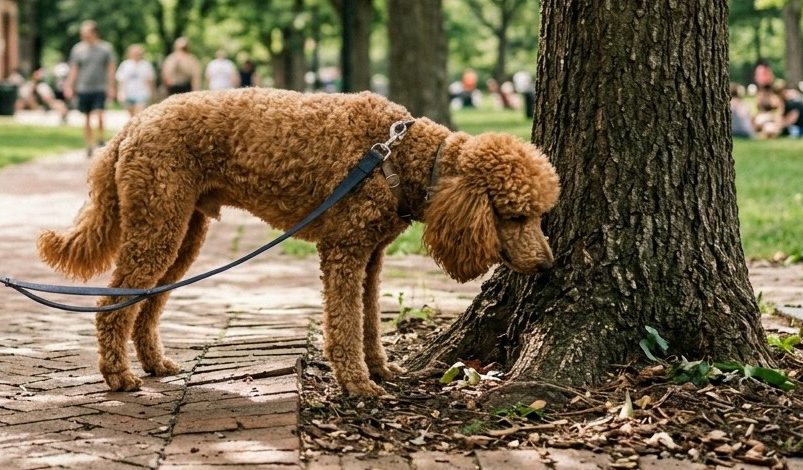
A dog standing at the base of a tree on a quiet residential block off Lincoln Park for two full minutes, reading it.
A walker holding a slack leash, not checking a watch, letting the dog decide that the next interesting thing is six feet to the left.
We choose the calmer side streets over the busy commercial stretches. We let the dog set the direction and the pace. We barely cover ground, and that is not the walk going poorly. That is the walk working exactly as intended.
The brick sidewalks and quiet rowhouse blocks the Hill is full of are genuinely good for this.
The trick is choosing them deliberately instead of marching a wound-up dog down the busiest route available.
How Do I Know If My Dog Needs One?
Watch what your dog does after a walk, not just during it.
A dog who comes home, drinks, and settles into a satisfied nap got a walk that fit them. A dog who comes home and cannot stop moving, who paces or seems keyed up rather than tired, is telling you the walk raised their arousal instead of lowering it. If that is the pattern, more of the same kind of walk is unlikely to fix it.
A few things to notice: Does your dog seem to escalate as the walk goes on rather than relax into it? Do they fixate on every dog and noise? Do they pull hard the entire way? Those are signs of a dog whose system is running hot and who would likely do better with a slower, sniff-led walk than a faster one.
Can a Wound-Up Dog Settle With the Right Walk Over Time?
Often, yes, and it is worth being honest about why.
We are not training your dog out of anything. We are giving their nervous system regular chances to practice coming down rather than ramping up. A dog who gets to decompress consistently tends to find their way to calm more easily, because settling, like anything, gets easier with repetition. The change you may notice at home, a dog who unwinds faster after walks, who seems less permanently keyed up, comes from the walk fitting the dog, not from a behavioral fix.
Some dogs are simply high-energy by nature, and that is wonderful. The aim is never to dampen a dog. It is to give a wound-up dog a real path back to settled.
Frequently Asked Questions About Decompression Walks on Capitol Hill
Isn’t a tired dog a good dog?
A physically exhausted dog is not the same as a calm one. You can tire a dog’s body and still bring home a dog whose nervous system is running hot. For a wound-up dog, the goal is regulation, not exhaustion, and a slow, sniff-led walk often does more for that than a hard one.How long is a decompression walk?
Our walks run roughly 20 to 25 minutes. With a decompression walk, the length is not the point and distance is even less so. A dog might cover very little ground and get exactly what they needed. Purpose drives it, not the clock.My dog pulls the whole walk. Is that the same thing?
It can be related. Constant pulling is often a sign of an over-aroused dog whose system is revved up. A slower, sniff-led walk that lets the dog set the pace frequently eases the tension, because a dog who is processing the world at their own pace has less reason to strain against the leash.Do you offer decompression walks on Capitol Hill?
We do. Decompression is one of the walk types we match to a dog’s needs, alongside enrichment, standard, and inside days when going out is not the right call. Here’s how to know which walk type fits your dog. We work with you to figure out which fits your dog, and it can change over time as your dog does.Wondering If a Decompression Walk Is What Your Capitol Hill Dog Needs?
You watched your dog come home wired one too many times and started wondering whether you were missing something. You were not missing a flaw in your dog. You were noticing that the walk and the dog were not matched. The right walk for a wound-up dog looks unhurried and quiet and a little uneventful, and it sends a dog home settled in a way distance alone never will.
If you are curious whether a decompression walk is what your dog needs, set up a virtual meet-and-greet.
No pressure, no sales pitch. Just a real conversation about your dog and whether what we do is the right fit for what your dog needs.
Every dog deserves a walk of their own.
Tracy Murray is the founder of Saving Fido Dog Walking, the only Fear Free and BAT Foundations certified private dog walker exclusively serving Capitol Hill. She’s also Pet First Aid and CPR certified, and she personally trains every walker on her team before they ever clip on a leash.