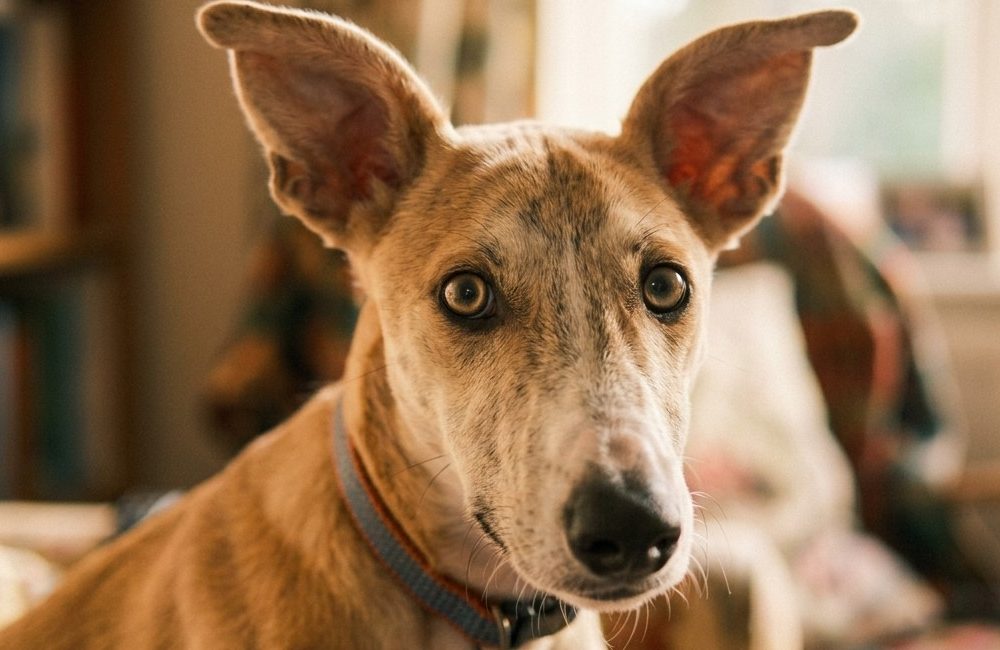
Which walk type does my dog need? Most Capitol Hill dogs do best with one of three kinds of walks. If your dog comes home from walks more wound up than when they left, they likely need a Decompression Walk, slow and sniff-heavy. If your dog is restless, bored, or getting into things at home, an Enrichment Walk gives their brain something real to do. If your dog just needs solid, reliable daily exercise and a routine they can count on, a Standard Walk is the fit. Most dogs do best starting with Standard or Decompression, then adjusting as you learn what they respond to.
I founded Saving Fido after years of working with dogs on Capitol Hill, starting back in 2007, first at the Washington Humane Society (now the Humane Rescue Alliance), then as a professional dog walker. Today I’m Fear Free and BAT Foundations certified, Pet First Aid and CPR certified, and I hold a psychology degree that’s turned out to matter just as much with dogs as it does with people. I personally train every Saving Fido walker before they’re trusted with a single client.
One question comes up in nearly every meet and greet: which walk does my dog actually need. It’s a fair question, and it’s the right one to ask. A walk isn’t just time outside, and Capitol Hill isn’t a blank backdrop, it’s Lincoln Park, Stanton Park, brick sidewalks, sirens, and a lot happening on every block. The wrong walk for a given dog in an environment like this can leave them more stressed, not less. This guide walks through all three types, so you can make an informed call before your first booking, and adjust anytime after.
Why Does the Walk Type Matter More Than the Walk Length?
Most walking services sell time. Thirty minutes, an hour, same walk regardless of who’s on the other end of the leash. But two dogs can walk the same Capitol Hill block for the same 25 minutes and come home in completely different states, one settled and satisfied, one wound tighter than when they left.
That’s because a walk isn’t one thing. A dog who’s overstimulated and gets a brisk walk down a busy corridor like Barracks Row comes home more activated. A dog who’s understimulated and gets a slow, sniffy walk around a quiet residential block comes home just as restless as they started. The walk has to match what the dog actually needs that day, not a generic template.
This is why Saving Fido never ranks the three walk types against each other. None is better. None is more advanced. They’re different tools for different Capitol Hill dogs, and sometimes different tools for the same dog on different days.
What Is a Decompression Walk, and Which Dogs Need It?
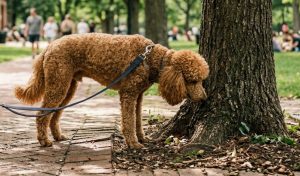
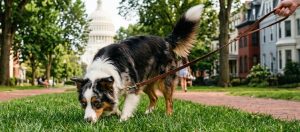
A Decompression Walk is slow, sniff-heavy, and completely dog-led. There’s no agenda and no pace to keep. The walker follows the dog, not the other way around.
This is the walk for dogs who come home from a regular walk more wound up than when they left. If your dog is anxious, easily overwhelmed by Capitol Hill’s noise and traffic, or just genuinely a lot to handle on a leash, a Decompression Walk is the reset button, not the workout.
What it looks like in practice:
- The dog chooses the direction at intersections when it’s safe to do so
- Extended time at anything the dog wants to investigate, a specific patch of grass, a scent trail, a particular tree
- No rushing between stops, no correcting the dog for stopping
- Minimal distance covered is normal and expected
What you’ll notice at home: A dog coming off a Decompression Walk tends to settle faster. Less pacing, less panting, more likely to lie down and stay down. Their nervous system had room to do what it needed to do.
If your dog fits this description, the deeper dive on why dogs come home from walks more wound up than they left covers exactly what’s happening in a dog’s body during a walk like this, and why sniffing does more work than most Capitol Hill dog parents realize.
What Is an Enrichment Walk, and Which Dogs Need It?
An Enrichment Walk is built around mental stimulation. New routes, varied terrain, and natural problem-solving, not just distance covered. The goal is a dog who comes home mentally tired, not just physically tired. The American Kennel Club notes that mental exercise is just as important as physical exercise for a dog’s overall health, not a nice extra.
This is the walk for dogs who are restless at home. Chewing, pacing, getting into the trash, bouncing off the walls the second you sit down. That’s rarely a bad dog. It’s usually a bored one. A dog with a sharp mind and nothing to do with it will find something to do with it, and you usually won’t love what they pick.
What it looks like in practice:
- New streets and routes instead of the same loop every time, alternating between the Pennsylvania Avenue corridor and the quieter blocks around Stanton Park
- Varied terrain where it’s available, curbs, steps, different surfaces
- Time built in for the dog to work out a problem, navigating around an obstacle, figuring out where a scent trail leads
- More exploration, less straight-line walking
What you’ll notice at home: A dog who’s had real mental engagement tends to settle differently than one who’s just physically tired. Less of the wired, can’t-quite-settle energy you sometimes see after a purely physical walk. More of a genuinely satisfied, done-for-the-day calm.
Best for: working breeds, high-drive dogs, and any dog who seems to have more brain than outlet. Capitol Hill’s mix of quiet residential blocks and busier commercial corridors actually works in an Enrichment Walk’s favor. There’s a lot of real variety within a few blocks of most Capitol Hill addresses, more than a dog would find looping the same suburban cul-de-sac.
What Is a Standard Walk, and Which Dogs Need It?
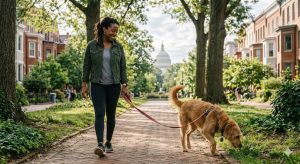
A Standard Walk delivers reliable daily exercise with a consistent route and a solid routine. Same structure, dependable pacing, the anchor point in a dog’s day.
This is the walk for dogs who don’t need a reset and don’t need a puzzle. They need what most dogs need most days: to get outside, move their body, and have something predictable to count on. If your dog waits by the door and you hate that they wait alone all day, a Standard Walk is the dependable midday break that shortens that wait and gives their day real structure.
What it looks like in practice:
- A consistent route the dog comes to know and anticipate, the same loop past the same Capitol Hill rowhouses and the same corner tree, every time
- Steady pacing, not rushed, not aimless
- The same basic shape to the walk each time, which is exactly the point
- Room for normal sniffing and normal dog behavior, without being dog-led the way a Decompression Walk is
What you’ll notice at home: Not a dramatic before-and-after the way you might see with Decompression or Enrichment. That’s the sign it’s working. A Standard Walk isn’t solving a problem, it’s maintaining a good baseline. Consistent, content, well-exercised.
Best for: dogs without a specific behavioral pattern to address, dogs new to Saving Fido while we’re still learning them, and dogs whose Capitol Hill dog parents just want dependable, quality exercise without over-engineering it.
What If I’m Still Not Sure?
Start with Standard. It’s the safest default because it gives your dog solid, reliable exercise while we get to know them individually. Every new client’s dog profile gets reviewed personally before the first walk, and the walk type isn’t locked in forever. If your dog’s Standard walks reveal that they’re actually understimulated, or if a stressful week has them more wound up than usual, we adjust. This isn’t a menu you pick once. It’s a match that can change as your dog’s needs change.
Can My Dog’s Walk Type Change Over Time?
Yes, and it often does. A young dog who needs Enrichment at eight months might settle into Standard as an adult. A dog going through a stretch of stress, new baby, construction next door, a move, might need Decompression for a few weeks even if they’ve never needed it before. The walk type follows the dog, not a fixed label.
This is part of why Saving Fido keeps walks private and one-on-one on Capitol Hill. Reading a dog well enough to know when their needs have shifted only works one dog at a time. A walker managing four or five dogs on a group walk can’t track this kind of change on a busy Hill block. A walker who’s with just your dog can.
Frequently Asked Questions About Walk Types
Can a dog get more than one walk type in a week?
Yes. Some dogs do best with a mix, an Enrichment Walk on high-energy days and a Decompression Walk after a stressful one, like a busy Saturday with Eastern Market crowds nearby. This gets worked out together as we learn your dog.
Does my dog’s breed determine their walk type?
Breed can point toward a tendency, working breeds often do well with Enrichment, for example, but it’s not a rule. Individual temperament matters more than breed. Two golden retrievers on the same Capitol Hill block can need completely different walks.
What if I pick the wrong one?
There’s no wrong pick to worry about. Walk types aren’t locked in, and we’re watching for signs the current type isn’t landing the way it should. If something’s off, you’ll hear about it, with a plan for what to try instead.
Is one walk type more expensive than another?
No. None of the three walk types is priced differently or positioned as an upgrade. They’re different, not tiered.
How do you decide which walk type a new Capitol Hill dog gets?
Every new dog profile is reviewed personally before the first walk. If anything about your dog’s history, energy, or temperament points clearly toward one walk type, we’ll say so. Otherwise, Standard is the starting point and we adjust from there.
Find Your Dog’s Fit
You know your dog better than anyone. If something in this guide sounded exactly like your pup, that’s useful information for your virtual meet and greet. If nothing quite fit, that’s useful too, it just means we’ll figure it out together once we actually meet them.
Every dog deserves a walk of their own. Book a virtual meet-and-greet anytime.

Tracy Murray is the founder of Saving Fido Dog Walking, the only Fear Free and BAT Foundations certified private dog walker exclusively serving Capitol Hill. She’s also Pet First Aid and CPR certified, and she personally trains every walker on her team before they ever clip on a leash.