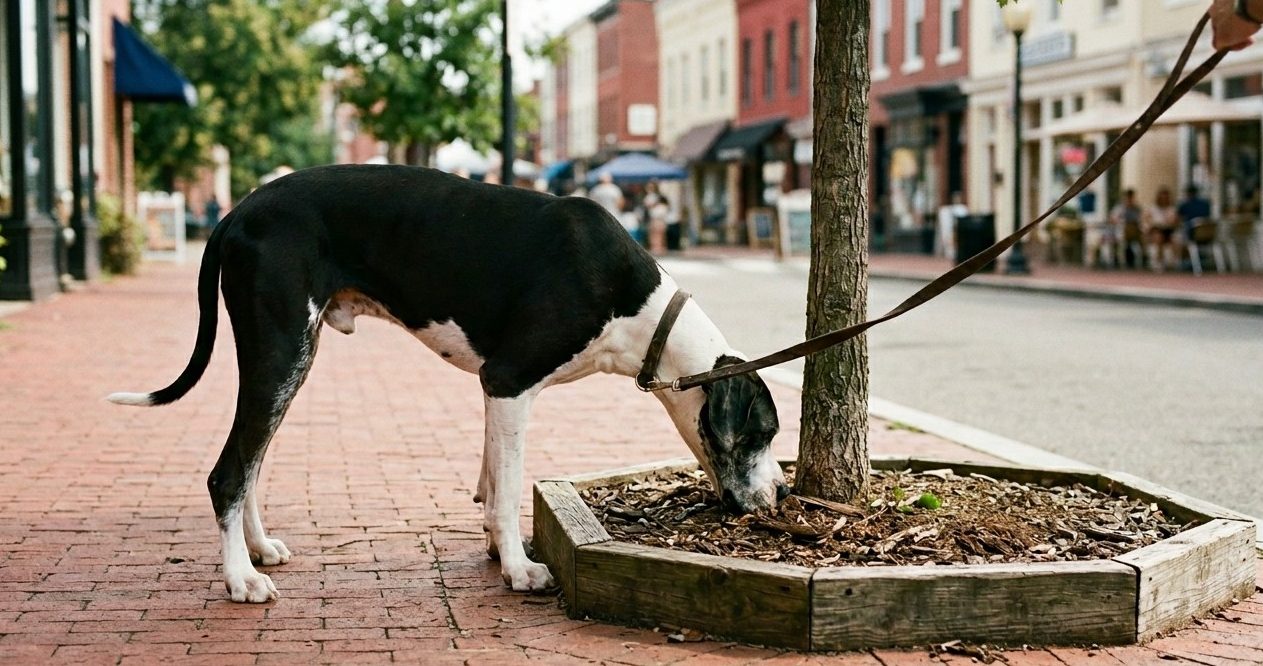
You’re halfway down the block and your dog has stopped. Again. Nose buried in the base of a tree box on East Capitol, completely absorbed, going nowhere. You give the leash the gentlest suggestion and get nothing back. They are busy.
It can feel like your dog is being slow, or difficult, or willful. They aren’t. They’re doing the single most important thing a walk can offer them, and most of us, trying to get around the block and back to our day, accidentally cut it short.
Quick Answer: Why do dogs sniff everything? Because scent is how they read the world, the way we read a room with our eyes. A dog’s sense of smell is tens of thousands of times sharper than ours, and the part of the brain devoted to it is proportionally enormous. Sniffing isn’t a detour from the walk. For a dog, it largely is the walk. A slow, sniffy twenty minutes on a Capitol Hill block does more for a dog’s mind and nervous system than a brisk march twice as long.
I’ve been working with dogs since 2007, starting at the Washington Humane Society (now the Humane Rescue Alliance) before becoming a professional dog walker and eventually founding Saving Fido. I’m Fear Free and BAT Foundations certified, Pet First Aid and CPR certified, and I bring a psychology degree to the job that’s proven just as useful with dogs as it is with their people. Every walker on my team trains under me personally before taking on a single client. I’ve watched a lot of Capitol Hill dogs sniff a lot of tree boxes, and I want to tell you what’s actually happening when they do.
Why Does My Dog Stop to Sniff Everything on Capitol Hill?
Capitol Hill, from a dog’s nose, is one of the richest places in the city. Brick sidewalks that hold scent. Tree boxes every few feet. A steady flow of other dogs through Lincoln Park and Stanton Park, each leaving a record behind. Where you see a quiet residential block, your dog reads a busy, detailed message board updated by everyone who passed through since the last rain.
So when your dog stops at a particular spot and won’t be hurried, they’ve found something worth reading. Who was here. How long ago. Whether it was a dog they know. It’s not nothing, and it’s not stalling. It’s the most natural thing in the world for them to do, and on a neighborhood as dense with information as Capitol Hill, there’s a great deal to take in.
What is Sniffing Like to a Dog?
Here’s the way to picture it. For us, a walk is mostly something we see. We look up and take in the block, the trees, who’s out, the light. We get the whole scene in a glance and then we’re ready to move on. For a dog, almost none of that matters. Their walk is something they smell, and smell doesn’t arrive all at once the way a view does. It arrives in layers, one spot at a time, each one read closely before the next.
So when your dog stops at a tree box and you’re standing there waiting, picture it this way: you’ve already finished looking at the view, and your dog is still on the first paragraph of a long, fascinating letter. You’re not waiting on a dog who’s being slow. You’re waiting on a dog who’s still reading.
Why Does Sniffing Matter So Much?
So why do dogs sniff with such intensity? A dog’s nose isn’t just a better version of ours. It’s closer to a different sense entirely.
Scent-driven dogs have somewhere around 300 million scent receptors in their nose. We have about 6 million. The part of the brain that processes smell is, proportionally, around forty times larger in a dog than in a person. So a dog isn’t getting a stronger version of what we smell. They’re getting a kind of information we mostly can’t access at all.
Some of how this works is genuinely remarkable. A dog’s nose is built so they can breathe and smell at the same time, air for the lungs and air for scent analysis travel slightly different paths, so a fresh stream of information never has to stop. They smell in stereo, too. Each nostril samples a little independently, which helps a dog tell not just what a smell is but which direction it’s coming from and whether it’s getting stronger or fading. That’s how a dog follows a trail. They’re reading change across space and time.
And the information itself is layered. A single spot on a Capitol Hill tree box can tell a dog which animals passed, how long ago, and possibly whether it was a dog they’ve met before. Researchers who study dog cognition, the long-running labs in Budapest and at Arizona that have spent decades on this, describe scent as a dog’s primary channel for understanding the world, as central to them as vision is to us. When your dog puts their nose down and goes still, that stillness is concentration. It’s the most mentally engaged moment of the whole walk.
When you give this instinct a structure, it has a name: nose work. It’s simply scent work turned into a game, hiding food or a scent for a dog to find and letting them use their nose to solve it. Dogs love it because it’s the thing they’re built to do, and it tires them in the deep, satisfying way that matters. The same instinct your dog uses to read a tree box on a Capitol Hill sidewalk is the one we can put to work anywhere, including indoors.
Does a Slow, Sniffy Walk Really Beat a Long One?
Once you understand why dogs sniff, something surprising follows: the walk that covers the least ground is often the best one.
Mental work tires a dog the way physical work does, sometimes more. A dog who has spent twenty minutes reading scent, making choices about where to go, and processing a Capitol Hill block’s worth of information comes home genuinely satisfied. Tired in the good way. The kind of tired that ends in a long drink of water and a deep nap, not the wired, still-looking-for-something restlessness of a dog who was marched around fast and never got to use their brain.
A longer, faster walk isn’t more for a dog. It’s just more distance. If the goal is a dog who comes home settled and fulfilled, a slower walk that lets them sniff and choose does more than twice the mileage at a clip. We don’t measure a walk in distance. We measure it in the dog who comes home.
Does Sniffing Actually Calm a Dog Down?
It does, and there’s a reason for it, not just a feeling.
When a dog puts their nose down and works a scent, they settle into slow, focused nasal breathing, the steady rhythm of a dog concentrating rather than the fast panting of a dog who’s keyed up. That kind of focused sniffing engages the rest-and-digest side of a dog’s nervous system, the part responsible for calm. It’s close to what a focused, absorbing task does for a frazzled person. Attention narrows, breathing settles, and the dog comes back down.
You could think of it as a dog’s version of the deep breath we take to steady ourselves, except theirs is automatic and comes with a whole world of information attached. We have to remind ourselves to slow down and breathe. A dog gets the same regulating effect for free, just by doing the thing they’re already built to do. Alexandra Horowitz, who runs a dog cognition lab and has written widely on how dogs experience the world, is among the researchers whose work points to sniffing as genuinely good for a dog’s emotional state. For a dog who finds the world a bit much, that makes sniffing one of the most reliable ways they have to bring themselves down a notch.
This is why on a Decompression Walk, a slow, sniff-led, unhurried walk that lets a dog process the world at their own pace, we follow the dog’s nose rather than a route. The sniffing isn’t incidental to that walk. It’s the whole mechanism.
How We Build Sniffing Into a Capitol Hill Walk
When we leave your dog’s door, we ask a simple question: left or right? And we let your dog answer.
Most walking, even good walking, is the human deciding and the dog complying. We flip it. Your dog sets the direction and the pace, and if what they want is to stand at one tree box on a Capitol Hill side street and take in everything that happened there this morning, we let them, even if we barely leave the block. That’s not a walk going wrong. That’s a walk going exactly right.
It’s dog-led, never dog-run-amok. Your dog doesn’t get to drag us into the street or rush another dog. We defer to what your dog needs inside the boundaries that keep them safe, two hands on the leash, always aware of what’s coming down the Capitol Hill block. Agency, with safety around it. The leash stays slack not because we’re permissive but because a dog who’s getting the walk they actually need has no reason to pull.
What Happens When the Walk Comes Inside?
On a dangerous-heat day, or in weather that isn’t safe for Capitol Hill pavement, the walk comes indoors, and nose work is exactly how it keeps working. An Inside Walk isn’t a cancellation or a lesser visit. Your dog still gets a brief, safe potty break outside, then comes in for the indoor version of what they’d be doing on the sidewalk: scatter feeding, a muffin tin with treats tucked under tennis balls, hide and seek, a box search. The reason a dog comes home from one as content as from a long sniffy ramble is that it’s the same engine. Reading a tree box and finding kibble in a muffin tin are the same instinct, just indoors. The weather changed the form. It didn’t change what the dog got.
How Can You Give Your Dog More Sniff Time, Even Without Us?
You don’t need us to do any of this. Some of the best things you can give your dog cost nothing.
Let them lead sometimes. Pick one walk, or part of one, where you have no destination and no pace in mind, and let your dog choose where to go and how long to linger. It will feel slow. That’s the point.
Take a sniff walk. Pick a short outing where the whole goal is sniffing, not distance. You might only reach the end of your Capitol Hill block. Your dog will come home like they covered a mile.
Try a little nose work at home. Instead of a bowl, scatter a portion of your dog’s kibble across the grass or a patch of floor and let them hunt for it. Hide a few treats around a room and let them search. A few minutes of this before you leave for the day can take the edge off a long stretch alone, because a dog who’s used their nose is a calmer dog.
Don’t rush the good spots. When your dog finds something genuinely absorbing, give them the ten seconds. It’s a small thing that tells your dog the walk is partly theirs.
Frequently Asked Questions About Why Dogs Sniff
Is it bad to let my dog sniff everything on a walk?
Not at all. The opposite, really. Letting a dog sniff is one of the most enriching things a walk can offer. The only limits are safety, no eating things off the sidewalk, no pulling into the street, which is about supervision, not about stopping the sniffing.
Should I let my dog sniff or keep them moving for exercise?
Both have a place, but most dogs get plenty of physical movement and far too little scent time. If you have to choose, a sniffy walk usually serves your dog’s mind and mood better than a fast one. The ideal is a walk with room for both, led by what your dog needs that day.
Why does my dog want to sniff the same spot every day?
Because the message keeps changing. That tree box or hydrant is a spot lots of Capitol Hill dogs use, so the information there updates constantly, like checking the same feed for new posts. Your dog isn’t being repetitive. They’re catching up on what’s new since yesterday.
How long should I let my dog sniff one spot?
Longer than feels natural to you. Ten, fifteen, twenty seconds at a good spot is normal and good. You’ll usually feel your dog finish and choose to move on. Letting them reach that point on their own is part of the gift.
Want a Walker Who Lets Your Dog Sniff?
If your dog comes home from walks still restless, or you’ve never quite known whether they’re getting what they actually need, this is exactly the kind of thing we pay attention to. We read each Capitol Hill dog and match the walk to them, whether that’s a slow, sniff-led decompression walk or a brain-busy enrichment one, and on unsafe-weather days, an Inside Walk that keeps their nose working indoors.
No pressure, no sales pitch. Just a real conversation about your dog and whether what we do is the right fit for what your dog needs. You can set up a virtual meet-and-greet anytime at savingfidodogwalking.com/contact/.
Every dog deserves a walk of their own.

Tracy Murray is the founder of Saving Fido Dog Walking, the only Fear Free and BAT Foundations certified private dog walker exclusively serving Capitol Hill. She’s also Pet First Aid and CPR certified, and she personally trains every walker on her team before they ever clip on a leash.