
Who is leading whom on a walk? We have all day to walk, drive, or bike wherever we want, and for most dogs the only time they are outside is with us. It is a fair question to ask.
Quick Answer: At Saving Fido, we let the dog lead at least half of every walk. In a dog-led walk, the dog decides when and where to stop, sniff, or just be. Unless there is a safety reason to step in, there is no agenda, no destination, and no clock on the sniffing. The other half covers the practical parts, like crossing streets and getting where we are going.
I’m Tracy, founder of Saving Fido and the only Fear Free and BAT Foundations certified private dog walker exclusively serving Capitol Hill. I’m also Pet First Aid and CPR certified, I’ve worked with dogs since 2007 (first at the Washington Humane Society, now the Humane Rescue Alliance), and I have a psychology degree that has turned out to be just as useful with dogs as it is with people. I’ve spent close to two decades on these blocks learning to read dogs, and that is where the dog-led walk came from.
Here is how we think about it, what a dog-led walk looks like on the street, and what we do when a pup does not want to walk at all.
Why do we let the dog lead?
Because the walk is the dog’s one chance to choose. Think about how differently we and our dogs get to move through the world. We have all day to walk, drive, bike, or ride wherever we want. We pick the route, the pace, and the stops, and we can change our minds halfway there.
For most dogs, the only time they are outside is with us. The walk is not one of many options. It is the whole outdoors, once or twice a day. So we ask ourselves a simple question: if the walk is their only window, do we still need to lead all of it?
Our answer is no. That is why we hand the lead to the dog at least half the time.
What does a dog-led walk look like?
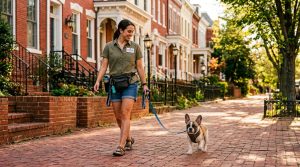
A dog-led walk is aimless on purpose. The dog sets the pace, picks the direction when it is safe, and stops for as long as they want to stop. We follow, watch, and keep everyone safe.
In practice, that looks like:
- Aimless. There is no mile to hit and no loop to finish.
- Meandering. The route zigs and zags, doubles back, and sometimes covers one block in twenty minutes.
- No goal. Nobody is trying to get anywhere.
Yep, that is the point.
The walk is theirs. It might be a pup working through a pile of leaves like they are reading a newspaper. It might be a careful investigation of what the other dogs on the block left behind. It might be a treat we surreptitiously dropped in the grass a few steps back, and the joy of finding it on their own.
It might also be a long stand at the base of a tree doing absolutely nothing, which is also allowed. The walk is their chance to be themselves, to explore, to choose with their nose, to get out and walk.
What about the other half?
The other half of the walk is for the practical parts. That is getting where we are going, crossing streets, and steering around anything that is not safe. It is also where we do a little leash skills practice with the pups who are working on it.
We step in when:
- A dog is heading toward traffic, a bike, or a scooter
- There is broken glass, a dropped chicken bone, or anything else that should not go in a mouth
- Another dog is approaching and the situation looks tense
- A pup is showing signs of stress and needs a different route
- The weather is unsafe for paws or bodies
When we step in, we do it calmly and with positive reinforcement. No yanking, no scolding, no punishment.
Why does sniffing matter so much?
Sniffing is how dogs read the world. A dog’s nose is their main way of taking in information, and the walk is when they get to use it. A pause at a hydrant is the news, the neighborhood gossip, and a check on who has been by.
That is why sniffing gets real time on our walks. It is also why we build Decompression Walks into our work. These are slow, sniff-heavy, dog-led walks with no agenda, and they suit overstimulated, anxious, or sensitive pups. They tend to come home calmer because they got to do what dogs are built to do.
For more on the science behind it, see our post on why dogs sniff everything, and our guide to which walk type your dog needs.
Why does a dog-led walk make sense on Capitol Hill?
Because the Hill is a lot for a dog. Between sirens, cyclists, tourists, political events, and street festivals, a city dog takes in more in one block than many dogs do in a week. Add the crowds on Barracks Row, Eastern Market weekends, and the foot traffic around Lincoln Park and Stanton Park, and a pup has plenty to process.
Letting the dog lead gives them room to manage that. A pup who needs to slow down can slow down. A pup who wants to watch a squirrel for five minutes can do that. A pup who wants to turn down a quieter side street can pick the quieter side street.
For us, letting the dog choose is both kind and practical. A dog who gets to process what they see and smell tends to come home more settled.
Can a walk have choice and structure?
Yes. For us, they work side by side. A dog-led walk still has a walker paying attention, a leash held with care, and a plan for if something goes sideways. What changes is who makes the small decisions. We hold the safety, and the dog holds the pace.
Frequently Asked Questions About Dog-Led Walks
What if my dog does not want to walk?
It is about choice. Some days we do not want to do something, and as adults we get to make that call. Yes, there are consequences, but we still have the choice.
We try to give dogs that same choice. If a pup is hesitant at the door, we slow down, give them a minute, and let them show us what they need. Sometimes that is a short sniff around the stoop. Sometimes it is a few steps and then home. Sometimes it turns into a long, slow stroll after all. A “no” is information, and we treat it that way.
If a dog says no often, we let their pet parent know so they can look into it together, possibly with their vet.
Will my dog get enough exercise on a sniff-heavy walk?
Often, yes. Sniffing is mental work, and it tires a dog out in a different way than a fast walk does. Many pups come home more satisfied after thirty minutes of investigating a block than after covering twice the distance.
For pups who need more physical exercise, we can build that into the practical half of the walk, or choose a Standard Walk or Enrichment Walk. We match the walk to what the dog needs that day.
Is it safe to let a dog stop whenever they want?
Yes. Safety is the one thing that overrides the dog’s choice, and we watch for traffic, hazards, and other dogs the whole time. If something looks wrong, we step in.
What about a dog who pulls toward everything?
That is common, especially with excited or young dogs. We use calm, force-free methods to help a pup learn what a loose leash feels like, and we still leave plenty of time to sniff. Pulling usually tells us a dog is eager to explore.
Does a dog need a fenced yard or a big park for a good walk?
No. Some of the best dog-led walks happen on a single city block. What matters is the freedom to explore at their own pace, not the amount of space.
How we build this into every walk
At Saving Fido, we do private, one-on-one walks. One walker, one dog. That is what makes a dog-led walk possible. The walk runs at the dog’s pace, with no one else’s schedule to match.
We are Fear Free and BAT Foundations certified, and Pet First Aid and CPR certified, with a psychology degree and a background of working with dogs since 2007. Every walk ends with a real update with photos, so pet parents know what their pup chose to do.
Want a Walker Who Lets Your Dog Lead?
If you are curious what a walk of their own would look like for your pup, we would love to hear about them. No pressure, no sales pitch. Just a real conversation about your dog and whether what we do is the right fit.
You can book a virtual meet-and-greet anytime. You can come too.
Every dog deserves a walk of their own.

Tracy Murray is the founder of Saving Fido Dog Walking, the only Fear Free and BAT Foundations certified private dog walker exclusively serving Capitol Hill. She’s also Pet First Aid and CPR certified, and she personally trains every walker on her team before they ever clip on a leash.